
Bits of Kids’ Brains by Mike Lucas (Ginger Cat Book)
Reviewed by Dianne Bates
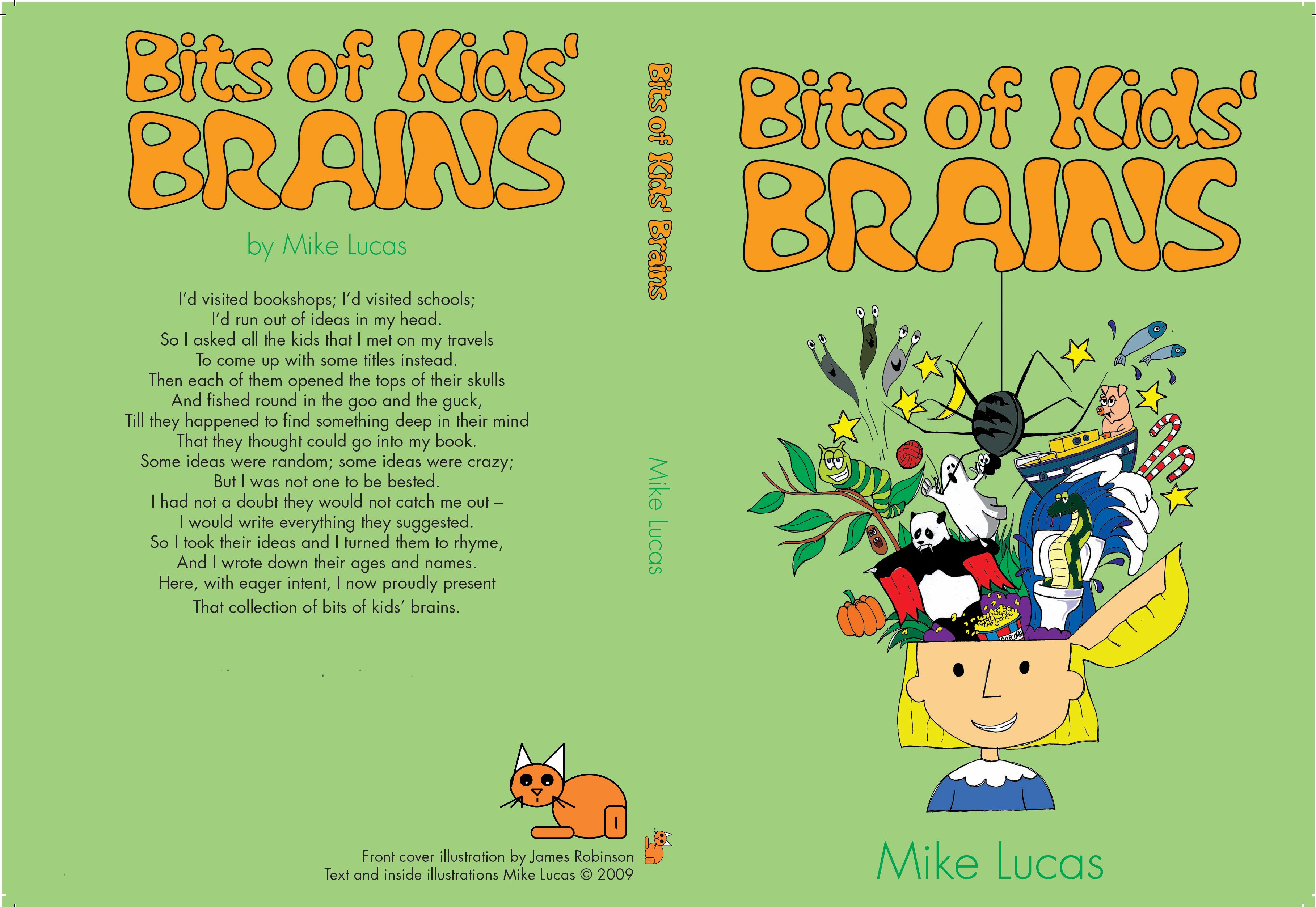
On the back cover blurb, Mike Lucas explains how this book came into being: he’d run out of ideas so he asked children ‘to come up with titles instead’. Thus, he says, ‘I took their ideas and turned them to rhyme/And I wrote down their ages and names’; subsequently, in this 174 page paperback, he ‘present(s) that collection of bits of kids’ brains.’
The 80+ poems are found under sub-headings: animals, school, space, words, toilets, bugs, beasties, things and ‘other’, most with intriguing titles such as ‘A footballer spider,’ ‘The dog that fell down the loo,’ and ‘Pirates who live under giant pants.’
The first thing that struck this reviewer was that most of the poems are long, some running to four pages and in small print. All are single spaced and there are occasional black and white cartoon illustrations. Many poems are presented as narratives such as ‘The evil pig who (sic) could fly’. Written in an A/A/B/B rhyming quatrain pattern, this poem starts with some Royal Ginger Nuts ‘gobbled up by peasants who’d not eaten for a week.’ Accused of stealing the biscuits, Prince T blames ‘an evil, flying pig.’ Soldiers are subsequently sent out by the King to capture the porcine thief. To cut a long story short, the pig is taken to court where it eventually swallows the prince. The poem is indeed a long stretch of nonsense which lends itself more to being read out aloud rather than read on the page.
With children generally unused to reading poetry, one wonders if the length of most of these poems might not deter them from tackling the long poems in this collection. There are some shorter poems, such as ‘Bad Santa’. Unfortunately, this particular eight-line, two-stanza verse is spoilt by a grammatical error – ‘Is (sic) there not more useful gifts/that you can learn to give?’ Errors such as this can be found occasionally in other verses. Sometimes, too, the end words of lines do not have full rhymes such as in ‘Roman Singing’: ‘You couldn’t hear them warble/And Christmas carols weren’t around/Within their baths of marble.’ Another problem that occasionally occurs in this collection is incorrect line scanning. It would probably serve Lucas well to work with other poets critiquing his work before publication.
‘Roman Singing’ is a clever poem which looks at the achievements of Romans in the days of Emperors (central heating, aqueducts and government) but it laments, in the final lines, the fact that one never hears of Romans singing. Another poem, which is great for reading aloud (perhaps with a chorus), is ‘Prehistoric wolfmen arguing over a mammoth topped pizza’. (Ollie Handcock, aged 10, who inspired the poem certainly set a challenge to the poet with this title!) In this poem, Lucas uses invented language (‘Uggag-bugga-gug/Me’ungry mungy mug’/Ooga-booga-boo/Me ‘ungrier ‘an ‘oo) which is sure to have children chortling. Despite the lack of ‘real’ words, the poem is easy to understand and lots of fun.
Lucas set himself an enormously difficult task to take ideas such as a girl whose older brother is like a monster (using lots of similes!), five Martian mice and a rat down the plughole and so on. Sometimes the task results in convoluted poems that need to be pruned (or discarded); other times the poet is equal to the task. Overall, it’s obvious that Lucas enjoyed the poetry challenge. He now regularly visits schools, libraries and anywhere that will listen to him for poetry readings and workshops.
 Australian Children’s Poetry