
Molecules and atoms all
vibrate to Thermo’s beat.
Their energy’s identified
by measuring the heat.
Like line-dancers they stay in form
and keep their solid state
when Thermo’s music’s playing cool
and doesn’t change its rate.
By turning up the temperature
they break-dance out of line
and move about as liquid to
our Thermo’s up-beat time.
And when it’s hot they leap about
like maniacs with jazz,
escaping from their dance floor as
they change into a gas.
The winter in New Zealand can
be beautiful with snow,
a solid state of water which
is icy H2O.
And as the sunshine heats it up
its molecules go hip
and melt into a liquid that’s
in puddles, pools and drips.
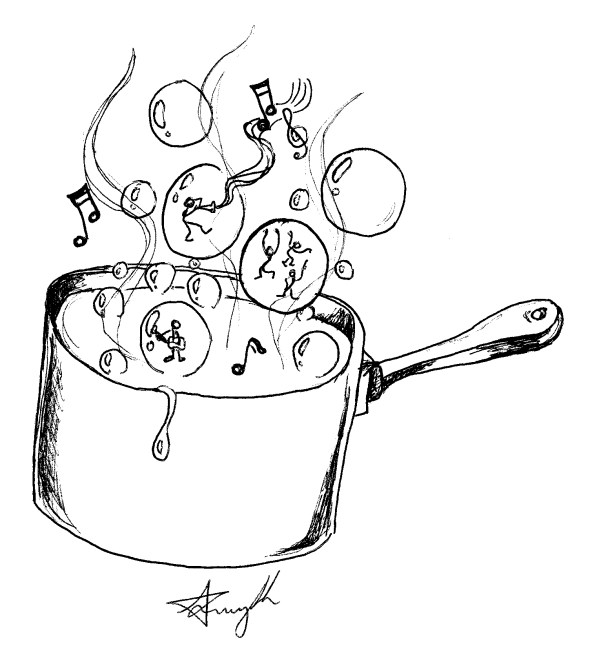
Now pour some water in a pan
and heat it on a stove.
You’ll see the bubbles forming
then escaping in their droves.
We know that’s steam or vapour
that is wafting from the pot.
You’ve witnessed water’s three-phased states
from freezing, warm and hot.
When solids change to liquid form
it’s called their melting point.
That temperature is different
for different elements.
Hot volcano temperatures
can melt Earth’s crusty rock
while Nitrogen on Triton’s only
found as gas or frost.
Elements and compounds can
exist in different phases,
solid, liquid or as gas.
It varies as heat changes.
And out in space those temperatures
can really be extreme
from freezing void to hottest sun
and all that’s in between.
But even in our universe
the coolest it can go
is measured as one Kelvin,
never Absolute Zero.
This name describes the temperature
where atoms fail to move.
If Thermo turned their music off
they couldn’t even groove!
 Australian Children’s Poetry