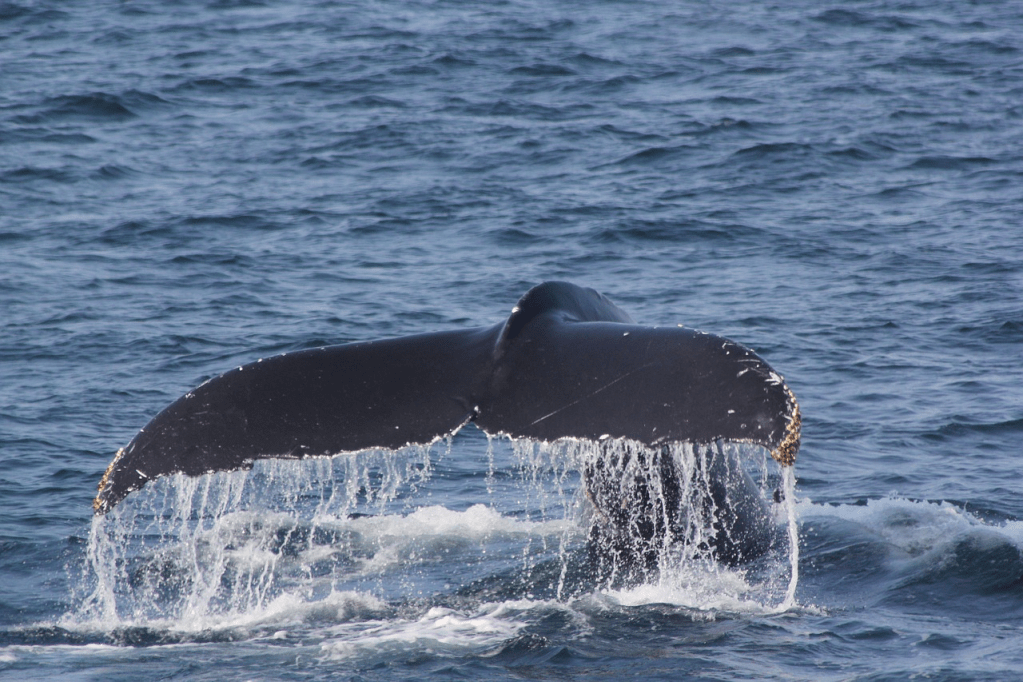
Wild June day whales put on wide vista performance. Travellers watch. In close mother with calf by her side breaks the water. A huge whale follows. Way out to sea another blows spume of water rolls. His fluke goes up then a gigantic s p l a s h.
Is saving our Earth a great idea? Then we must make stop those blinded with greed, using fossil fuels till they disappear. Is saving our Earth a great idea? Good ecologists, our future should steer–– we need a world with clean air, water, feed. Is saving our Earth a great idea? Then we must make stop those blinded with greed.
Straw-coloured spines, black tips laid back, rotund creature waddles around garden. It pokes its head into a plastic box, rolls onto a large termite-tunnelled log, climbs over it. Heading towards a giant shell under a tap, it stops to snuffle up ants. Its long tubular snout searches the shell’s base. At snout’s tip a tiny mouth appears, and a long sticky tongue licks up cooling drops.
It no longer exists, the thylacine, though dog-like creature calls, stripes flick through bush. Tracking wallaby by scent, tail extended behind, the animal is rarely seen.
Overlooking lightly-wooded scene, rounded ears pricked, is it a thylacine? Struck by its kangaroo behind, many rush to phones, make calls. Yet few rangers are sent to check sightings in the bush.
Walkers hike in lonely bush, dangers not often seen. But is smell of musk scent a sign of the thylacine? Researchers follow up calls, hoping to sight a striped behind
If they come up behind a strange wolf in the bush giving coughing barks or yipping calls, is it an illusion they’ve seen, because extinct is the thylacine? Still they cannot let go of the scent.
Tasmanian trappers noted musk scent when they followed behind extended heel tracks of a thylacine. Where’s proof it exists in the bush? Do hundreds mistake what they’ve seen? When others laugh, few make calls.
ARFRA* records all calls, hurries to chase up a scent, wants hard proof of what’s been seen. One day they hope to sneak up behind the strange creature frequenting the bush to identify without doubt the thylacine.
In time, with calls, a brown striped behind, peculiar scent in the bush, proof will be seen of the extinct thylacine.
Image from Digital Classroom. Note: *Australian Rare Fauna Research Association, website https://www.facebook.com/AUSRFRA/. A sestina consists of six stanzas, of six lines each, and a concluding tercet. The end word of each line of the first stanza is repeated in succeeding stanzas and tercet in a strict order.
Did you call me a grasshopper? No way; I’m a cricket. I’m one of two hundred eggs my mum laid in the soil.
Do you reckon I look like a mini-adult? Sure I do because I shed my skin as I grow and get a new one.
Notice I don’t fly much at all? Why? Because I can’t–– my wings are too small. See, I jump, jerk my way around.
Notice the tooth-like bits on my wings? Only males have them. Listen, I can rub them together. Hear a chirping sound? It attracts the cricket chicks.
Ever heard me chirping at night? That’s because I’m a nocturnal guy and coldblooded so I liven up in the warm. I’m warm now––hear me chirp.
Look out, here comes a lizard! Hide me––I don’t want to be its snack. Or a frog’s, a big spider’s or a tortoise’s. Me, I love yummy fungi, plants, insects.
See my fancy compound eyes? They let me look in many directions at once. Check out my antennae, my feelers–– they pick up movement, help me catch prey.
Japanese and Chinese people reckon I bring good luck. So make sure you’re nice to me.




 Australian Children’s Poetry