What’s Behind The Wall by James Aitchison

Leave a comment

A waterwheel that slowly turns,

A river there that swiftly churns,

A secret garden in the sunWhere lazy dreams are gently spun.

Where is this drowsy mill house found, Where insects buzz in sleepy sound? 

In France!  For there, midst ancient walls,

Legends live and history calls.

Teacher’s note: This old mill house is in Castelfranc on the River Lot.

Melting Sun by James Aitchison

Leave a comment

The sun melts

into the far hills;

the lake catches fire 

as the heat spills.

Night is coming now

this land to fill;

will tomorrow be

more perfect still?

Polish Spring by James Aitchison

Leave a comment

In a Polish village,

opening to the sun,

I found all these flowers

when spring had well begun.

What a splash of colour,

I was lucky to be there,

where ancient wooden houses

huddled round the square.

A Chat With An Orangutan: an experimental poem by James Aitchison

Leave a comment

“Hello, kid,” the orangutan said.
“You look very familiar.”

“That’s because,” the young boy said,
“We’re both very similar.”

“But I don’t live in a house, boy,”
The wise orangutan said.

“It doesn’t matter,” the young boy said,
“Where you lay your head…

“The fact is, you and I are friends
“From way back deep in time.”

“If that is so,” the orangutan said,
“Put your hand in mine.”

Teacher’s note: In Bahasa (Indonesian and Malay languages), orang means “man” or “person”, while utan means “jungle”. Thus, the orangutan is a man of the forest. Many experts now believe that the orangutan — not the chimpanzee — is closest to humans in traits and characteristics.

My Hidden House by James Aitchison

Leave a comment

I have a hidden house

in a garden full of flowers,

and I love to sit in silence

and gaze at it for hours.

The little house was built

in the Gold Rush so I’m told,

but for me it is a treasure

worth more than any gold.

Teacher’s note: This miner’s cottage, built in 1860, is typical of many homes built in the 
Ballarat, Creswick and Clunes district during the Victorian Gold Rush.

The Antarctic Beech by James Aitchison

Leave a comment

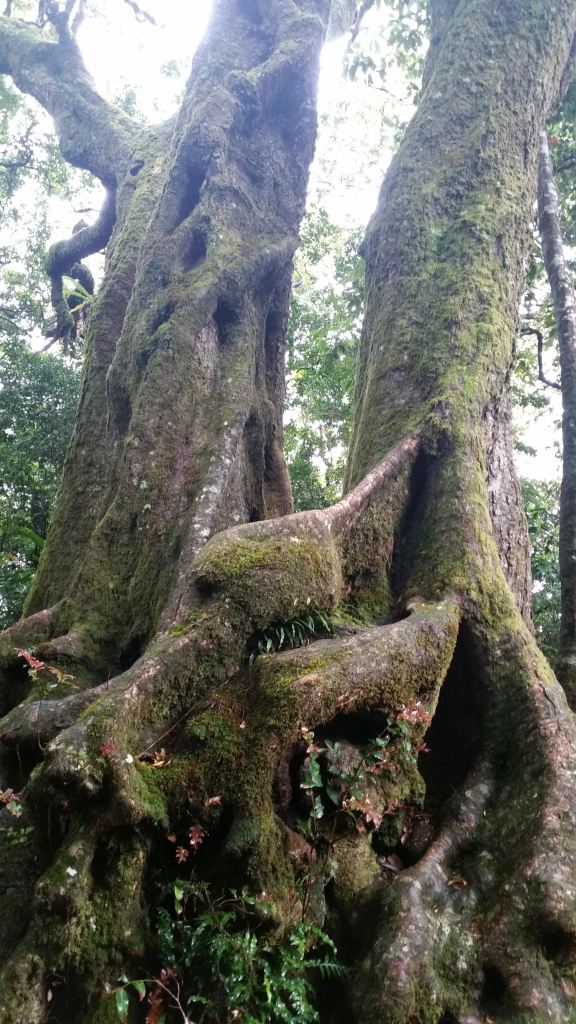
I wandered in a forest deep

and found this ancient tree.

Two thousand years it’s grown here;

lots more it well might see.

They said it’s called a Beech,

born in forests long ago,

before Antarctica 

had turned to ice and snow.

Teacher’s note: Lamington and Springbrook National Parks are located on the Scenic Rim of the Gold Coast hinterland.  Two hundred and twenty-five million years ago, the continents of South America, Africa, Australia and Antarctica, along with India, New Zealand, Madagascar and Arabia made up a single land mass called Gondwana.  When Gondwana broke up 120 million years ago, Australia remained attached to Antarctica. Seventy million years ago, when Antarctica was covered with rainforests, Australia separated and moved north. This Antarctic Beech has survived to this day. Sadly much of the ancient rainforest was lost to logging in the 19th Century.

The Beach That Squeaks by James Aitchison

Leave a comment

Step onto its glistening sand

and hear the squeaky sound.

Then find the granite boulders,

big and red and round.

What a beach to visit, 

listen to it talk,

simply take your shoes offand take a little walk.

Teacher’s note: Squeaky Beach is part of the Wilsons Promontory National Park

The Sleepy Koala by James Aitchison

Leave a comment

Oh boy, what a day,

I’m ready for a doze.

I’m full of yummy gum leaves

from my ears to my toes.

A little snooze would be nice,

It’s what koalas do.

So please don’t wake me up

Until half past two.

Silly Sculpture by James Aitchison

Leave a comment

He’s holding up the building,

With only his left hand.

But both his legs are missing —

I don’t understand!

What a silly sculpture,

It made me want to laugh;

How can you hold up a building

When you’ve been cut in half?

Teacher’s note: The city of Vienna has many ornate sculptures
decorating its buildings.

Message from Mr. Ostrich by James Aitchison

Leave a comment

“It’s wrong!  It’s wrong!”

the ostrich said.

“I never, never

bury my head!

If I did

how could I see?

You mustn’t believe

such things about me.”

Teacher’s note: Ostriches do not bury their heads in the sand.  When trouble approaches, they lie low and press their long necks to the ground.  Mostly, ostriches escape danger by running at up to 72 km/h.  The world’s heaviest bird, they are also the world’s largest, fastest flightless bird, capable of killing predators such as lions and humans with a kick.