
Howling winds
from raging seas,
relentless, wild,
distort the trees.
Stunted growth
in salty air,
in sandy soil,
forlorn and bare.
Yet even here
we find beauty,
in harsh and tangled
symmetry.
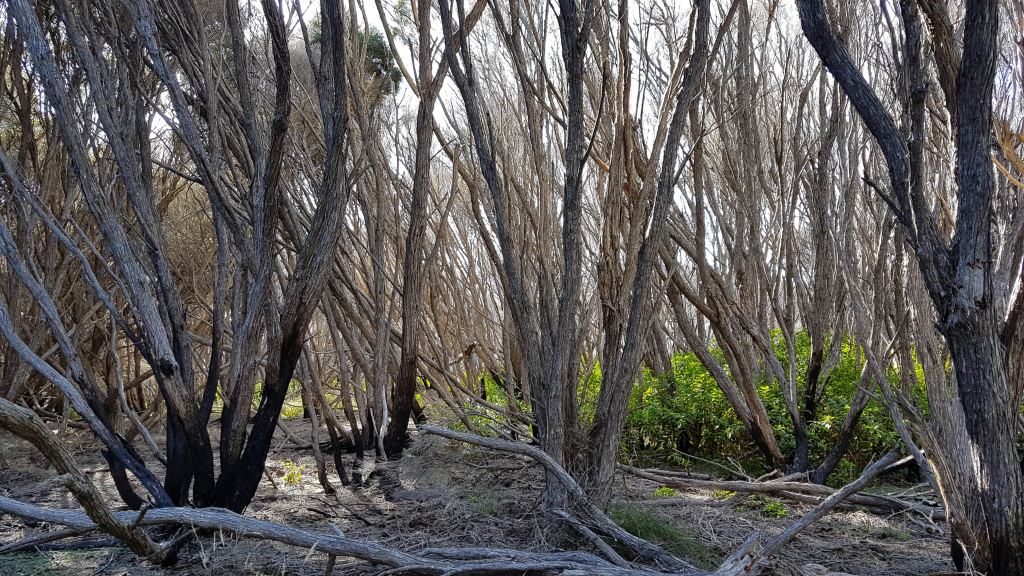
Howling winds
from raging seas,
relentless, wild,
distort the trees.
Stunted growth
in salty air,
in sandy soil,
forlorn and bare.
Yet even here
we find beauty,
in harsh and tangled
symmetry.
a poem can be quite funny
a poem can be quite sad
some poems are really sensible
while others are quite mad
some are rather silly
designed to fashion laughs
with talk of roosters ducks and geese
or large long necked giraffes
but poems can tell a story
not just be rhyming word
a poem can make your heart take flight
on strong emotions stirred
a poem can give you pleasure
wonderous and sublime
of which there is no measure
take you to another time
and poems belong to everyone
just follow where they lead
turn the page and there they are
in thought word and deed
for poetry is ancient
a timeless limitless cloak
of thoughts and feelings infinite
as old as language spoke
There was an opossum
who wrote an opoem.
“O! look what I’ve done,”
the opossum opined.
At the oasis or
down by the ocean,
Opossum’s opoem
received an ovation.
Was it opossible
for an opossum
to write an opoem?
Oh yes, it owas!
Teacher’s note: Opossums are native to North and South America, while possums are native to Australia.
From the foot of Peppercorn Hill
I flow, from a boggy heath in
the Snowy;
I journey by Canberra,
then map my mighty course
past Gundagai and Wagga,
to where the Murray waits.
My river’s tale is fraught
with a dozen deadly floods,
yet my relentless waters
bless Riverina farms.
Since the dawn of time I’ve been
Australia’s Big Water —
the Murrumbidgee River,
the life source of my land.
Teacher’s note: The Murrumbidgee is Australia’s second longest river, edging the Darling into third place by a few kilometres. “Murrumbidgee”, in Wiradjuri language, means “Big Water”. The photograph shows the Murrumbidgee at Wagga Wagga.

On his trampoline jumps Max McKnight
but he sails too high!
He’s snapped up by an eagle in flight
passing by.
Thwarted, the eagle can’t swallow the boy
in one go,
so it opens its beak and drops poor Max like a toy
into his backyard below.
Teacher’s note: This experimental poem reduces the line-length of a sonnet from the traditional iambic pentameter, while preserving a typical rhyme-scheme.
I should have sent some flowers,
I should have sent a card,
but then I got so busy
and it was all too hard!
So I cut some nice red roses
at next door’s in the dark,
and added lots of other things
growing in the park.
It made a lovely gift
and didn’t cost a cent.
Isn’t it the thought that counts
and not how much I spent?
Milo and I took a stroll through the park.
Mum said “Remember! Be home before dark.”
We spotted a goanna hiding in the grass.
He was in our way so we couldn’t get past.
Milo can’t talk but he sure can bark.
He scared that goanna right out of the park.
We came upon a cassowary underneath a tree.
I didn’t like the way that he was looking at me.
Milo can’t talk but he sure can bark.
He scared that bird right out of the park.
We crept up on a snake that was resting in the shade.
It made a hissing noise and I felt quite afraid.
Milo can’t talk but he sure can bark.
He scared that snake right out of the park.
We noticed an echidna searching for some ants,
all around the tree roots and up and down the plants.
Milo can’t talk but he sure can bark.
He scared that echidna right out of the park.
Then I said to Milo it’s getting very dark.
It’s just about time that we were leaving this park.
But just as we’d decided we really shouldn’t stay,
who do you think was standing in our way?
With looks on their faces that made me start to shake,
goanna, echidna, cassowary, snake.
Standing at the front and peering through the grass
was old man goanna who wouldn’t let us pass.
And echidna and cassowary looking so mean
that my knees started knocking, what a frightening scene.
Waiting right beside them to give us such a scare
was snake with his forked tongue testing the air.
Milo can’t talk and he couldn’t even bark.
We were both so scared we ran right out of that park!
I saw some rocks in Ireland
and the farmer there explained,
“I built myself a little wall
to keep my sheep contained.”
“The big stones on the bottom,”
the smaller ones on top,
and it cost me not a penny
for my roaming sheep to stop.”
“And who needs to have a gate
when you have this kind of pen?
I just lift some stones away,
then put them back again.”
Teacher’s note: Dry stone walls are constructed of carefully selected interlocking stones without mortar to hold them in place. Found in hilly areas of Britain, Scotland and Ireland, especially in Connemara on the West Coast where large stones exist in the soil. One system of Irish dry stone walls was carbon-dated to 3800 BC. Closer to home, dry stone walls can be found in western Victoria, some parts of Tasmania, and around Kiama in New South Wales.

Mist weeps across the peaty land,
the breaths of ancient warriors
clothe the peaks.
High clouds roam above
the raw silence, a hint of gleaming
in their midst.
Once battles rolled throughout
these glens, as Highlanders
fought the King’s red-coated men.
No invader has stormed
these hills again, and peace
rests upon the folded crests.

Frances Felicity Frankenstein
Will you be my valentine?
Though your surname is not glamorous
Your smile always makes me amorous.
Last week when I held your hand
I knew our love was something grand.
We’ve been together twelve whole weeks,
Our bond is something quite unique.
Although you have a mono-brow
I still adore you anyhow.
It’s true three of your teeth are missing,
But I don’t notice when we’re kissing.
I love to hold you every day
And know that you will always stay.
Perhaps, come many years from now,
We could exchange wedding vows.
I’ll lift your veil and kiss your freckles;
Your name will then be Mrs Jekyll.
 Australian Children’s Poetry