“Baby Eucalypts” with Teacher Notes  by Celia Berrell

Leave a comment

Baby Eucalypts


When fire has passed,

eucalypts are reborn.

Tough woody capsules

release their seeds,

falling on ash

which is nutrient-rich.

Plunging their roots

into first-rained earth,

their view of the Sun

helps speed that growth,

for the canopy’s shade

is burnt and gone.


Animals fled.

So new leaves, uneaten,

make a dash

towards the sky.

No insects in sight

means delicate shoots

don’t get sucked dry

of their life-giving juice.

Alone in the quiet

on black-rich soil,

those baby trees have

the best start in life.


http://www.forest-education.com/wp-content/uploads/2017/07/eucalypt_adaptations.pdf

Fire has been a constant visitor to Tasmanian forests for millions of years. It has shaped the evolution of many plant species and communities. In fact, many species are not only adapted to fire, but actually have features that help to promote it. Fire is an essential part of the life cycle of many plant communities, including dry eucalypt forests and wet eucalypt forests. Fire behaves differently, however, in each of these systems. A key difference between eucalypts and rainforest trees is that eucalypts are adapted to, and take advantage of major, widespread disturbances of the forest canopy, especially those caused by fire. Individual trees of different species can withstand the effects of fire to varying degrees, but all eucalypt forest types depend on it to some extent for regeneration. Eucalypt seed release is triggered by fire, when tough, woody capsules empty their contents onto a nutrient-rich ash seedbed from which all the understorey competition for light, water and nutrients has been removed. Browsing animals are driven out for a time, and the heat-treatment of soil reduces the numbers of plant-eating insects and soil organisms during the short but crucial early growth period.

“Nari’s Hero Echo”  by Celia Berrell

Leave a comment

Nari’s Hero Echo

(A true dolphin story from 2009)


Nari’s grown up

meeting lots of

humans every day.

They feed him fish

and watch as all

the dolphins swim and play.


Along with best-friend

Echo he will

entertain the guests.

By herding fish

round paddling feet

that tickle them in jest.


He’ll let the humans

stroke him as

for people, that’s a “must”.

It’s how we say

“I love you” and

that care’s gained Nari’s trust.


But recently

poor Nari got

a shark-bite on his head.

An injury

so serious

it could have left him dead.


For three whole days

the people feared

that Nari must have died.

He didn’t come

to visit them

and many people cried.


Then Echo brought

his injured friend

to Tangalooma beach.

And coaxed poor Nari

‘til he swam

within the people’s reach.


They gently lifted

Nari from his

darkened sea of gloom.

And flew him out

to Sea World where

their vets could treat his wounds.


Nari’s back at

Tangalooma

showing off his scars.

The people are

ecstatic.  He’s

Australia’s dolphin star!


Have a read of the link to an article below

https://www.abc.net.au/news/2009-02-17/nari-the-dolphin-recovers-after-surgery/299910

“Meditations”  by Celia Berrell

Leave a comment

Meditations

Drifting on a tranquil lake

of mottled hopes and patterned faith.

Feeling peace and tenderness,

amidst your lucid water-ness.


And like a caterpillar nigh,

transforming to a butterfly,

I know there is a part of me

transcending through infinity.


This poem was inspired by the painting Melting Transitions Rise by Sharon Davson.


All four poems and pictures will feature in the artist’s biography DAVSON Art with Love and Graditude scheduled for the printers later this year.

“Mother of Invention”  by Celia Berrell

Leave a comment


Neo-natal humankind

is ceaseless of enquiring mind.

With science and technology

the stopper’s out dynamically.


From fire to furnaced energy

from steam to electricity.

We modify genetically

and glean the stars effectively.


We can’t slow down

this gain in pace.

The fascination’s

well in place.


Much to learn,

with good intention,

drives this mother

of invention


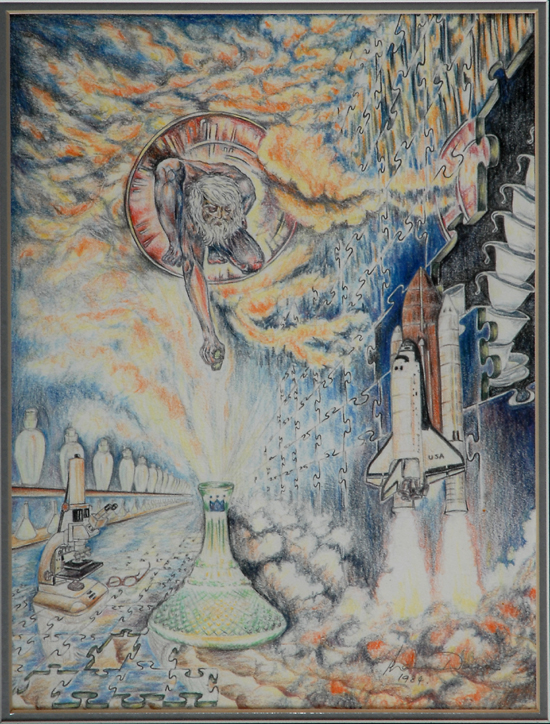
This poem was inspired by the crayon drawing Origins of the Future by Sharon Davson.

The poem was published in the Canadian school Textbook Nelson English 10 in 2012


“Peace by Piece”  by Celia Berrell

Leave a comment

Peace by Piece  

The world is getting smaller

and it’s breaking into bits.

Let’s put it back together

peace by piece

the puzzle fits.


Repairs can all be tended

by the tiniest of friends.

As working altogether

peace by piece

the puzzle mends.


This poem was inspired by the painting Together We Can by Sharon Davson.

The poem was published in the Malaysian school textbook English Form 1 by Pelangi Books in 2016

“The Beauty of it All”  by Celia Berrell

Leave a comment

The Beauty of it All

All we can touch, and all we see

began in cosmic history.

How long ago came things to be?

Perhaps it was infinity.


All our surroundings hold in store

the clues to what has gone before.

A fascination long prevails

to understand time’s every tale.


Our tiny Earth holds precious gifts

as through the universe it drifts.

With organisms varied, rife,

are we alone in having life?


This special form of energy

enduring in its frailty,

bestows such beauty, all admired,

intelligence is awe-inspired.


This poems was inspired by the painting Called Away by Sharon Davson.

The image and poem were published in the Australian school textbook Macmillan English 7  in 2011

“Snowy Sugar- OSES” by Celia Berrell

Leave a comment

“Tower Power” with a link to live science by Celia Berrell

Leave a comment


A group of giraffes 

is called a tower.


Each day, they sleep 

for less than an hour.

They’ll munch on leaves 

from acacia trees,

while ear-flicking flies 

in savannah’s breeze,

reaching up high 

with grace and ease …


giraffes shouldn’t need 

to climb those trees!


Teacher Notes

Link to live science


https://www.livescience.com/27336-giraffes.html

“Mustard Gas Legacy”  by Celia Berrell with Teacher Notes

Leave a comment


Soldiers smelled garlic;

horseradish; sulphur.

A kind of fusty

mustardy odour.

Then twelve hours later

they’d start to go blind,

get pus-filled blisters

and possibly died.


Chemist Fritz Haber

in World War One,

made mustard gas poison

worse than a gun.

This silently sneaky

chemical tool

spread crippling pain

that was very cruel.


Survivors were checked.

When blood tests were done,

most of their body’s

immune cells had gone.

They’d lost the white cells that

could turn into cancer.

Was mustard gas poison

a possible answer?


From a weapon of war

to helping the sick

this chemical cocktail

became our first pick

to fight against cancer.

A new remedy!

Oncology’s

chemotherapy.


What I regards as an appropriate link and 4min video for this topic 

https://montrealgazette.com/opinion/columnists/the-right-chemistry-mustard-gas-and-the-beginnings-of-chemotherapy


The Right Chemistry: Mustard gas and the beginnings of chemotherapy


The Bari bombing was not the key to the development of chemotherapy. That dubious “credit” goes to the 1917 mustard gas attack at Ypres.

JOE SCHWARCZ, SPECIAL TO THE MONTREAL GAZETTE 

Updated: September 13, 2019

Dr. Joe Schwarcz: Mustard gas and chemotherapy4:03

SHAREADJUSTCOMMENTPRINT

It makes for a compelling story. The Second World War is being furiously fought across Europe. The Allies finally gain a foothold in Italy and the port city of Bari becomes a critical point of entry for troops and supplies to the Mediterranean theatre. The harbour is filled with ships on Dec. 2, 1943 when Nazi airplanes drop from the clouds, their bombs raining destruction.

The SS John Harvey, an American ship carrying a cargo of 2,000 mustard gas bombs in spite of the Geneva Protocol of 1925 that banned the use of chemical weapons, explodes, killing all of its crew and spreading the gas across the harbour and town. But the clouds from which the Nazi planes emerged have a silver lining. Researchers note that the victims of mustard gas exposure have a very low rate of white blood cell multiplication, suggesting that mustard gas could also interfere with the characteristically rapid multiplication of cancer cells. And so it is that the Bari attack serendipitously leads to the development of mustard gas as an anti-cancer drug and launches the concept of “chemotherapy.” At least that is the way the story is told in numerous text books and articles.

A nice romanticized account, but the fact is that the first use of a modified version of mustard gas to treat cancer in a human was in the United States in 1942, more than a year before the Bari attack! The seminal event that gave rise to the treatment was indeed a mustard gas attack, but one that the Germans unleashed on Allied troops at Ypres in Belgium in 1917.


“A Recipe For Dew” by Celia Berrell

Leave a comment

A recent rain

to quench and share.

A cloudless night

to cool the air.


The slightest breeze

to chill on cue

the grass and leaves.

Here comes the dew.


The stage is set

for dawn’s sensation.

Jewel-studded

condensation.


Blanket-strewn

on grassy stems

are rainbow-sparkling

water gems.


first published in CSIRO’s Scientriffic magazine No 85, July 2013