“Giving” by JR Poulter

Leave a comment

“Happy New Year MU69” by Celia Berrell

Leave a comment


Notes

On the eighth day of Christmas (1st January), New Horizons (the space probe that took photos of dwarf planet Pluto back in July 2015) will be 6.6 billion kilometres from Earth, travelling at 14 kilometres per second, flying past a rock about 37 kilometres wide called 2014 MU69 (nick-named Ultima Thule) in the solar system’s Kuiper Belt.  If it doesn’t bump into anything on the way, we will receive images from its cameras just over six hours after they are taken.  This is an incredible technological adventure with cosmologically amazing consequences.  What an exciting way to start the New Year!


http://www.planetary.org/blogs/jason-davis/2018/nh-ut-100days.html


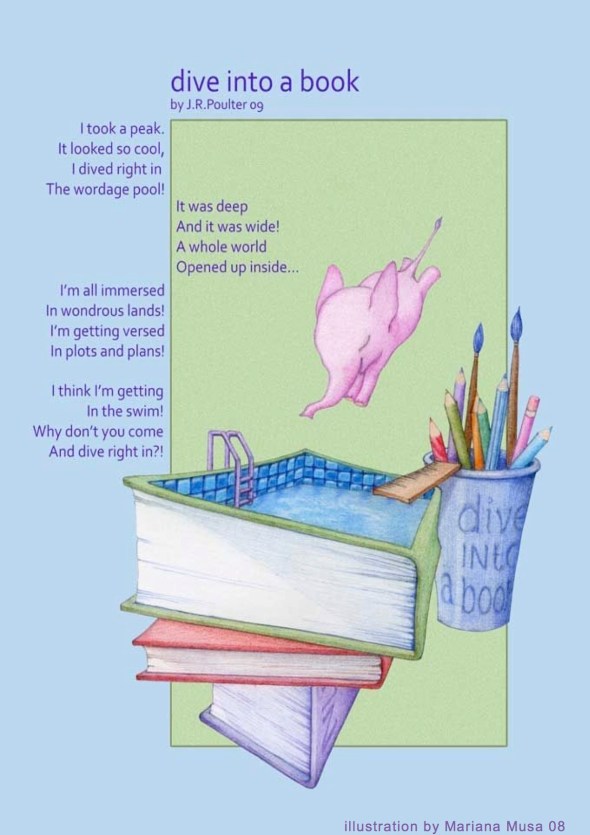
“Dive into a book” by JR Poulter

Leave a comment


“A SEASONAL TELESTITCH” by James Aitchison

Leave a comment

A SEASONAL TELESTITCH


The end of cold days:

Farewell! Adieu!

The sun rises warm

But expect a quick storm,

Then catch a wave —

It’s my kind of weather!


The sunsets glow red

Across Australia,

We’re all on holiday —

The best of all times!


James Aitchison


 TELESTITCH

A telestitch is the opposite of an acrostic.  Discover the poem’s hidden message by reading the last letter (rather than the first) of each line.

Give it a try

And most of all — have fun!

AARDVARK, APE, BARRACUDA, BUTTERFLY AND BEAR By Jan Darling

Leave a comment


AARDVARK, APE, BARRACUDA, BUTTERFLY AND BEAR


Crowds, rabbles and throngs, clubs, hordes and troupes

Are Collectives for people who gather in Groups

But what do we call friends who are woolly and furry

Barking or whistling, singing or purry?

When they get together with family and friends

What is the word for their special blends?


Let’s start with the alphabet, that means the A

Which letter was first from the Ark would you say?

It wasn’t the whale, the worm or the shark –

But a shy bunch of prickles we call the Aardvark.

If you should meet lots of aardvaarks at once

And call them an Armoury, you’d not be a dunce.


If you’re keen on games and like jokes and japes

You’ll be happy to meet a grouping of Apes

But what will you call them – this family of jokers…

This smart clever band of naughty provokers?

The word is descriptive, it’s perfectly apt

A *Shrewdness of Apes has them all neatly capped.


Now think of the sea, in the depths of the ocean

Where swims a predator in fast or slow motion

He is hunted and eaten, grows more than three meters

Provides tasty meals and feeds plenty of eaters

He’s a high-powered fish and fond of flattery

When found in groups it’s a Barracuda Battery.


Our next group of B is from land, not the sea

And some of his kind live and sleep in a tree

Some like the snow, others the jungle

The name for this lot seems a silly bungle

It’s a **Sleuth or a Sloth when you see many Bears

An affliction of fiction from hundreds of years.


The last of our B’s flies dainty and free

Over the land but seldom the sea

She does beautiful things with colourful wings

She dances o’er flowers as the sweet bird sings

A Flutter of Butterflies is commonly heard

But Kaleidoscope’s often the Collective word.


Jan Darling


Teaching Notes:


Sounds of the Aardvark:  soft grunts as it forages (looks for food like antnests); loud grunts as it approaches its nest entrance and soft bleats if frightened.


What do you call a group of Aardvaarks?


How many ‘As’ are there in Aardvaark?


Sounds of the Ape: sounds like something between a series of dog yaps and UGH!The sound is called a ‘jibber’.


What do you call a group of Apes?


What is the meaning of ‘shrewd’?


*Shrewd means both clever and sharp.   Apes are known to observe you closely, often appearing to deduce what your next move will be.


Sounds of the Barracuda:  Sadly, most fish sounds are inaudible to the human ear.  But if we could hear them, fish-talk would sound like purrs, grunts, hums, clicks and hoots.


What is a group of Barracuda called?

Information not included in the poem: Barracuda can grow up to 100 cm and weigh up to 9 kilos.    They can live 10-15 years because they have few natural predators – only man, sharks and the Orca whale.


Sounds of Bears:  Each Bear family has a different sound, they growl and when angry they roar, Bear cubs make a hoarse bawl when they’re scared, they also make whuffing noises and they moan and grumble.


What is the name for a group of Bears?


What characteristic does this name imply?


**Both Sleuth and Sloth come from Old and Middle English.  Some writers associate the idea of Bears often seeming to look for things with ‘sleuth’ or detective.  Most agree that Sloth comes from Old English Slow-th, meaning slow.  We now know that not all Bears are slow.  In fact you should never run from a bear – he can cover 50 yards in 3 seconds!   And your running will just encourage him.  


Yards: an imperial measure equal to the metric measure of  0.9144.    Discuss Imperial and Metric measures.


What sounds do baby bears make?


Sounds of the Butterfly:  they flutter – an onomatapoeiac word.


Onomatapoeia is a “figure of speech” – it describes a word that itself sounds like the subject it refers to!


What are examples of onomatapoeiac words?

Baa-lamb.  Baa is the sound that the lamb makes.  

Or sizzle – the sound that the steak makes.

Buzz – the sound a bee makes.


What is a group of butterflies called?


Information not included in the poem:  The butterfly has four different stages of growth: the Egg, 100-300 are laid at a time.  The Caterpillar: the egg produces a caterpillar which grows to its final size and then becomes the Pupa (which are usually attached to the underside of a leaf), which finally produces the Butterfly.


All sounds are available online.  Simply Google ‘Sound of the …’ and you will be taken either to a dedicated website or to YouTube.

“Making Poppies with Pa” by Kristin Martin

Leave a comment

Making Poppies with Pa


I traced the outline:

5 perfect petals

on the shiny red metal sheet.


Pa used the tin snips

snip, snip, snip

to carefully cut around the shape.


Together we hammered the petals up

one at a time.

“It looks like a leaky cup!” I laughed.


Then I sprayed

one puff of black

into the flower’s centre.


Pa attached the wire stem

and handed it to me

like it was a long-stemmed rose.


But when I carried our poppy outside

and proudly placed it in the new-turned dirt

Pa began to cry.


He knelt down so I could hug him tight

then whispered through his tears,

“I hope you never know what war really means.”

Kristin Martin
kristin@kristinmartin.net


“Fred, Ted and Ned” by Caroline Tuohey

Leave a comment

Fred, Ted and Ned.


I have a mate whose name is Fred.

“I’d like a verse,” is what he said.


So I sat down with sharpened lead,

and penned some lines that end in ‘ed’.


I wrote about a horse named Ned,

whose owner’s name was Mister Ted.


He built that horse a fancy shed;

He shod him, groomed him, kept him fed.


Ned had a rug of crimson red,

embroidered with a golden thread.


He wore that rug when Mister Ted,

last Sunday rode to church to wed


his girlfriend who had bravely led

an army – she had battle cred!


Then after vows they quickly sped,

along the road in wooden sled.

The sled was pulled, of course, by Ned.

The reins were held by Missus Ted,


while Mister Ted laid out a spread

of cakes and biscuits, jam and bread.


But now this verse must end dear Fred,

I’ve no more ‘eds’ left in my head!


Caroline Tuohey


“Sea Stalker” by Mary Serenc

Leave a comment

Teacher Notes by Jeanie Axton

1. Brainstorm words that describe sharks in general

This could be a starting point

http://www.rhymezone.com/r/rhyme.cgi?Word=shark&typeofrhyme=jjb

2. Look at the structure of a shark

3. Discuss students experiences of sharks and bring in the topic of shark safety

4. Now with all the brainstorming, knowledge and safety awareness of sharks start writing

5. Younger students could paste their poem in the shape of a shark for displaying in the classroom

“Fruity Beauties” by JR Poulter

Leave a comment

”Cyrch a Chwta: a Challenge!” by James Aitchison

Leave a comment

Cyrch a Chwta: a Challenge!

My cat adores nothing more

Than salmon, whiting and flake.

And as for my Labrador,

He demands a juicy steak.

But they will not eat them raw —

I cook them, for heaven’s sake!

My parrot says I’m cuckoo.

What to do?  I need a break.

James Aitchison

Cyrch a Chwta (pronounced kirch a choota), is a fun Welsh poetic form which has:

  1. An octave stanza (eight lines)
  2. Seven syllables per line
  3. A choice of two rhyming patterns: aaaaaaba or abababcb; the big trick is Line 7, which has to cross-rhyme internally with Line 8, on either the third, fourth or fifth syllable!

In my poem above, the schematic is:

xxxxxxa
xxxxxxb
xxxxxxa
xxxxxxb
xxxxxxa
xxxxxxb
xxxxxxc
xxcxxxb