Be a Science Week Poet!

Leave a comment

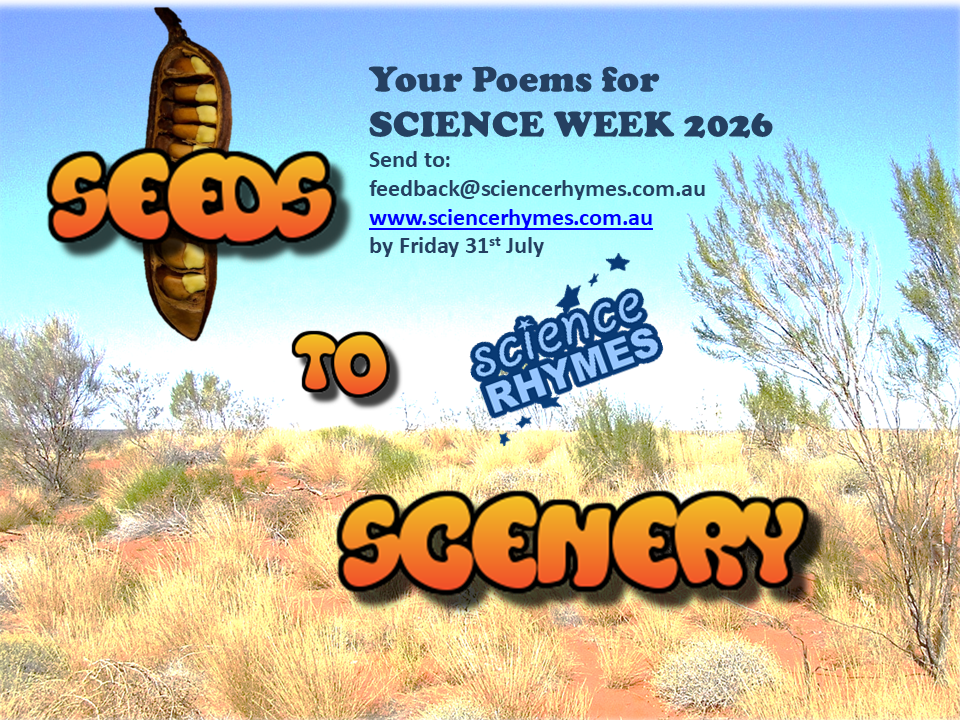
Celia at Science Rhymes is eager to receive your rhyming poems (up to 4 verses) – or Haiku – before the end of July. Adults and children (via an adult email address) are invited to submit their creations to feedback@sciencerhymes.com.au. The resulting FLORA-VERSE online anthology will be celebrating #scienceweek2026.

Our poetry collection is already growing. We’ve received poems about Seed DNA; invasive weeds; endangered wattle; and amazing grass trees. Anything plant-related that includes a touch of science, be it biology, chemistry or other STEM-related perspective, is very welcome.

We are particularly looking forward to publishing poems that feature vegetation found in Australia. From seeds to forests; from flowers to bees, this collection will include your thoughts and discoveries about plants and how they shape environments for a myriad of living things.

The use of AI to help create poems is permitted, but conditions apply. These include acknowledging the AI (such as ChatGPT) with the (human) author’s name; checking AI information for science errors before submitting; and answering 4 simple questions about your experience with using AI for this poem. 1) Were you delighted or disappointed with what AI came up with – give a score out of ten. 2) Did you edit the response? 3) Was your prompt simple or specific? 4) Would you do this again next year?

We still totally appreciate your “human-made” poems for their artistic and literacy values! We trust authors using AI will try to improve the creations they receive through editing and carefully checking facts.

Science Week runs from 15th to 23rd August.
Our deadline for receiving poems is currently Friday 31st July.

Find out more at:
https://www.scienceweek.net.au/event/seeds-to-scenery-poetry/ where you can download the SEEDS TO SCENERY pdf for more details and poem examples. Plus, check out National Science Week Events & Competitions for more activities.

Sturdy Mulga Trees by Celia Berrell

Stretching up towards the skies
or weeping boughs drawn by their sides,
iconic mulga, drab and droll,
still represent Australia’s soul.

In sunburnt soils on arid lands,
with long strong roots, the mulga stands.
High heat; cold nights are mulga’s fate.
In drought these trees can hibernate.

Their rugged bark with groovy tracks
can channel drips down trunks of black.
Instead of leaves, they’ve phyllodes.
Flattened stems that clatter breeze.

Mulga blossoms, tassled gold,
are quick to let sweet-scents unfold.
Flowering not for Spring, but rain.
Should water kiss their harsh terrain.

First published in POINTS OF INTERSECTION SCIENCE AND POETRY (page 35), held in the Scottish Poetry Library.  

World Poetry Day 21st March

Leave a comment

March 21st was declared World Poetry Day by UNESCO in 1999. It celebrates the power of words.  Connecting our kaleidoscope of languages and cultures throughout history, how will you participate? What might you do, think or read to commemorate this day of diverse verse?

Our Home is Dirt by Sea Anthology

Leave a comment

The following is an interview conducted by Rebecca Newman of Alphabet Soup with Dianne (Di) Bates, the founder of Australian Children’s Poetry blog about an Australian children’s poetry anthology Di has compiled.

RN: You are the commissioning editor for a poetry anthology for children coming out with Walker Books. What was your role in the book?                                                                                                                                                                                                   DB:I spent many hours finding poems which were written by Australians and which would suit the themes I’d decided on for the anthology (such as sport, families, being a kid). I had to record the source of each poem (if it was in a single poet collection, an anthology, a magazine or if it was unpublished). I also tracked down contact addresses of the poets, gave the anthology a title (Our Home is Dirt by Sea) and then had to find a publisher for the whole anthology. This all sounds easy, but it took me several years.

RN: There are a lot of poems in an anthology. Do all the poets get paid if they have a poem published in an anthology?

DB: Yes, poets are paid. As the editor, I get paid, as well. Unfortunately the publisher couldn’t include all the poems I wanted, because of financial limitations.

RN: Does an editor ever change the words in a poem once it’s accepted for an anthology? Does the poet have a say in any changes?

DB: I would never change the words — or the punctuation — in a poem without approval from the poet. I didn’t change any of the poems in my anthology.

RN: Can you tell us a bit about the upcoming anthology? DB: Titled Our Home is Dirt by Sea, the anthology consists of 60 poems in the following categories: Australia, Mostly Me, Families, People, Animals, Sport, School, and Special Times. A few of the poems are lyrical, some make children think and some are humorous, but all are child-friendly and relatively short. The style of poems ranges from rhyming verse to free verse. I aimed for poems which make the reader feel some emotion when reading them, and for children to ‘see’ themselves or the world around them. Some of the poets are well-known such as Steven Herrick, Elizabeth Honey, Doug McLeod and Max Fatchen, but others are lesser known (to children) such as Robert Adamson, Kyle Seeburg, Andrew Leggett and Rodney Hall. I have also compiled two other children’s poetry anthologies, but they are so far unpublished. And I’ve published a book of mad verse for children titled Erky Perky Silly Stuff (Five Senses Education).

RN: Do you write poetry yourself? (Does that help when you are selecting poems for an anthology?)

DB: Yes, I do write poems, but I don’t consider myself a very good poet. There are none of my poems in Our Home is Dirt by Sea, though there are a few by my husband, Bill Condon (who has published three collections). I know a lot about poetry from having a life-long love of poetry, teaching verse speaking, performing poetry and reading extensively. I’ve also run children’s poetry competitions and have a blog, Australian Children’s Poetry which showcases Australian children’s poets.
Poems organised through Robyn Youl

Leave a comment

The following poems were written by elderly patients in a Melbourne nursing home. Initials have been used to protect patient confidentiality. Prompts, which led to the formulation of the poems, are provided. Thanks to Robin Youl for this contribution.

Rusty
Rusty.

Big Ears
Small little feet.

I brush his long hair.

He licks my hand.
He loves me
Just me.
Nobody else
Just me.

S @ Grant Lodge. [Prompt: Nursing, brushing Papillon PAT dog]

My Rainbow

My Rainbow
a road.

There is no beginning
Because
You start
In the middle
Of
A Rainbow Road
If you want.

All colours
Are beautiful
I love them
Every one.

Walk on any colour.
Walk on all the colours
If you want.

A Rainbow Road
Leads to
A Blue Mist
Which surrounds you.
If you want.

V @ Grant Lodge [Prompt: V’s Painting of a Rainbow]

The Face.

I look up.
Just above me
That face.

Suspended, staring
Again.

Nothing
Passes between us.
I remain silent.
Perhaps she wishes to speak.
I do not know.

G @ Grant Lodge [Prompt: Recurring vision of this face]