Hibiscus In A Hurry by Celia Berrell

Leave a comment

The hasty Hibiscus has burst into flower.

A glamorous beauty that seems a bit rude.

Its bloom only lasts about twenty four hours

before it will wilt to a shrivelling prude.


Its pistil’s so long, like it’s poked out its tongue

to grab the attention of passers-by.

The tip has a group of five stigmas it’s hung

to catch any pollen before it will die.


Along the pink sides of its long pistil style

the anthers hold pollen that’s yellow and bright.

Like sparks flying off from a Catherine-wheel

or sparkler lit on a dusky night.


With silky-soft petals in reds, white or gold

they need to attract pollinators for hire.

Impatient, imposing.  They’re terribly bold.

Like flowery dragons all breathing fire.


Poem of the Day

Leave a comment

Silvery Riddle

I will give you a smile if you care to look up

but I won’t show my face on a dark, dark night.


I will rule over oceans as though they are slaves

but I won’t ever say if that’s wrong or right.


I will make a lake’s surface a silvery spread

but I won’t share my shine when the day is bright.


I will block out the Sun every once-in-a-while.

My Solar Eclipse is an awesome sight!

Celia Berrell


  • Submitted in response to Poetry Prompt #36

Celia said: There was a Total Solar Eclipse over part of the USA recently.  Our Moon is 400 times smaller, yet 400 times closer than the Sun.  This precise difference makes them appear the same size from Earth.  When they line up perfectly, it can take our breath away!  Imagine what a riddle this event must have posed to people centuries ago, before we really understood the movements of the stars, planets and our silvery Moon.

Poem of the Day

Leave a comment

Sir Isaac Newton’s Laws of Motion


Newton was a clever man.

An avid scientific fan.

He questioned many things he saw.

Like ones we had no answers for.


He thought them through right to their cores.

Then gave us many handy laws.


Newton’s First Law Of Motion:

Without a force of push or pull

an object will remain quite still.

With just one push at just one time

that object moves in one straight line.


Newton’s Second Law Of Motion:

A bigger Force accelerates

an object that is heavy-weight.

While objects of a smaller mass

don’t need much Force to move them fast.


So Newton noticed they obey

that Force will equal m times a.


Newton’s Third Law Of Motion:

Now bend a stick. Before it cracks

you’ll feel its force of pushing back.

For every action there will be

an equal one – opposingly.


Without his formulas in place

we’d soon get lost in outer space.

So Isaac’s Laws help us traverse

the reaches of our universe.

Celia Berrell
  • Submitted in response to Prompt #23

Celia said: Things need to move in order to travel. First published in 1687, Newton’s Three Laws of Motion were a scientific breakthrough for which he is very famous. These laws are still used today to calculate such things as the orbits of moons, planets and stars. And they’ll be very handy if you travel to Mars – a few decades from now!

Poem of the Day

Leave a comment

Springing To Action


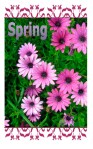
Sprr-r-r-ring is such an active word.

You can hear it gathering-up its force.

Ready to burst out a kind of ping.

Releasing its energy on a course.


It’s the name we give to the season when

all living things gear-up to abound.

We use it to label a water source

that’s pushing its way through the spongy ground.


It’s also the name we give a device

that bends and moves but will not crack.

It’s often metallic and flexible.

If it’s pushed or pulled it does the same back.


A spring isn’t always a coiled-up wire.

It could be a curve or a V-shaped bend.

Like a bow that shoots arrows through the air.

Or a pair of tweezers with open ends.


A spring can be made from a plastic mould.

A blister, a mound or a curvy dome.

They’re hidden in keyboards for typing things.

And once were used on an old mobile phone.


A pen you can click. A used paperclip.

A clock that goes tick. A peg that can grip.

A doorknob that twists. A bike-bell that rings.

It’s likely they’ve all got some kind of sprr-r-r-ring!

Celia Berrell
  • Submitted in response to Poetry Prompt #34

Celia said: Many Australians seem to have an easy-going approach to life.  Is this reflected in the way we say words like “spring”?  Other cultures and languages speak in a more animated way than us.  Can you “roll your r’s” like the Italian and Spanish people do?  Or gargle your “r’s” like the French?  How do you make the word “spring” really spring?

Poem of the Day

Leave a comment

An Album of Yesterdays

I caught a piece of yesterday

to share with you today.

It’s clinging to a memory

of how we laugh and play.


I know that piece of yesterday

will never go astray.

It’s squashed inside a heavy book.

That’s where it’s going to stay.


Tomorrow, when I’m old and grey

I’ll still remember yesterday

and how we used to play and laugh.

Because … I have our photograph!

Celia Berrell
  • Submitted in response to Poetry Prompt #32

Celia said: Personal pictures and photos have an almost magical connection with our memories and emotions.  And some become more precious as the Yesterdays slip by!  Do you treasure your analogue or digital album of Yesterdays?

Poem of the Day

Leave a comment

To Bee or not?

Is it a bee without a buzz?

It could be a bee with all that fuzz.

But then its wings stick-out too far

and all six legs have got no hair.


You want to know the reason why?

Because it is a bee-sized fly!


They seem to wear their bee-costumes

and pollinate the same bee-blooms.

Their females are a bee’s worst pest

and lay their eggs in real-bee nests.


To be a bee-fly small or large

it helps to be bee-camouflaged.

Celia Berrell
  • Submitted in response to Poetry Prompt #29

Celia said: This poem isn’t about bees.  Honest!

http://bie.ala.org.au/species/urn:lsid:biodiversity.org.au:afd.taxon:5c4d1b74-df10-4cda-9bfc-220490890500

Bombyliidae (Bee Flies)
Bee flies are large, fat, and hairy, often with a long, rigid proboscis. They are excellent mimics of bees, and may have black and yellow stripes along the abdomen. The adults are avid seekers of nectar from various flowers, although a few species feed on pollen. They are important pollinators, and can reach the nectaries of many wildflowers that are inaccessible to other flies. Their larvae are brood parasites on various species of bees and wasps.


Poem of the Day

Leave a comment

Will I? Won’t I?

Our senses are detectives


I hear a kettle boil and click.

I see the steam rise soft and thick.

I sense that kettle’s very hot.

Will I touch it?  NO I’ll not.


I see green mould upon the fruit.

I touch it and it feels too soft.

I smell the scent of yucky rot.

Will I taste it?  NO I’ll not.


I feel the raindrops on my skin.

I smell the dampness closing in.

I see the lightning on the hill.

Will I hear it?  Yes I will.


I see the smoke and bonfire blaze.

I feel its warmth upon my face.

I hear the crackling spits and spills.

Will I smell it?  Yes I will.


I hear a mossie’s whining flight.

It stops.  And then I feel a bite.

Will I see it? Not at night.

Will I squash it?  Yes I might!

Celia Berrell

Submitted in response to Poetry Prompt #27

Celia said: If asked to do something, people may say YES and then change their mind.  I tend to say NO first-up, THEN change my mind!  Which way round will it be for you?

Poem of the Day

Leave a comment

Snowflake Nucleation


Fabulous flecks

of feather-white fluff

gracefully fall

from a frozen sky.


But moisture and cold

aren’t quite enough

to make water droplets

solidify.


Most of those freezing

flakes of snow

use something alive

on which to grow.


Those Jack Frost patterns

will only start

when a microbe lies

at a snowflake’s heart.

Celia Berrell

Submitted in response to Poetry Prompt #28

Celia said: Fleeting, gentle, cool, melting … there’s something delightful about feeling the caress of a snowflake on my face. I can see all those rosy cheeks in the wintery weather down south. Love that snow!

Poem of the Day

Leave a comment

Drawing A Memory


How do you doodle?

Leafy-shapes or people?

Zigzag sharp

or swirly soft.

Spirals, squares or circles?


Why do we doodle?

Feeling tense or troubled?

Trying not to

go to sleep.

Puzzled, bored or muddled?


Doodling while listening

prevents our mind from wandering.

It helps to pen

a drawing-hook.

But NOT in someone else’s book!

Celia Berrell
  • Submitted in response to Poetry Prompt #25

Celia said: What’s the point of doodling?  Well it turns out that, rather than being a distraction, it can help us focus!  So go ahead – use your super-doodle power.  (My favourites are curls and swirls.)

Poem of the Day

Leave a comment

Too Late for Chocolate?


It’s best to say YES to sensible food.

Eat all our veggies

with meat well chewed.


It’s best to say YES to exercise.

It helps keep us fit

and also wise.


It’s best to say YES to a good night’s sleep.

With eight to ten hours

of dreaming deep.


BUT

It’s hard to say NO to late TV shows

with popcorn or ice-cream

or marshmallows.


SO …

You wouldn’t say YES, if handed a plate

of yummy baked cakes

or some sweet chocolate …

would you?

Celia Berrell
  • Submitted in response to Poetry Prompt #22

Celia said: When we’re tired, we are more likely to give in to temptations.  Well that’s my excuse.  What’s yours?

 Self-controlled people have better lives – but for the rest, lack of willpower is more like physical fatigue than moral failure, says Roy F. Baumeister, professor of social psychology at Florida State University.