“Pondering These Knees”  by Celia Berrell

Leave a comment

Pondering These Knees


Most animal legs

will have some knees.


Including birds,

including bees,


including dogs

like Pekinese,


including cats

like Siamese.


There’s also apes

like chimpanzees


and watery-mammal

manatees.


And most of them all

have kneecaps, two.


Including us,

the gnu, the shrew


and even frogs

have kneecaps too.


But NONE are found

on a kangaroo.


https://www.realclearscience.com/blog/2019/04/02/four_fascinating_facts_about_kneecaps.html

The patella, or kneecap, is one of the most incredible bones in your body. As a sesamoid bone, it is embedded within a tendon, where the quadriceps and patellar tendons meet. There, the rounded, triangular bone protects the knee joint and acts like a pulley, allowing the tendon to transmit more force with smoother motion.

Frogs may have evolved the first kneecaps. In 2017, researchers from Argentina discovered primitive, soft kneecaps in eight species of frog. “One implication of the discovery is that kneecaps like this began to evolve in the Devonian period 400 million years ago,” Andy Coghlan wrote for NewScientist.

http://kneesafe.com/fun-facts-animal-knees/

Fun facts about animal knees

AUG 10, 201718036 VIEWS

1. All four-legged mammals have 2 knees and 2 elbows. That includes dogs, cats, elephants, horses – all quadruped animals. Their front legs bend exactly like our elbows. When talking about horses for example, the parts that we commonly refer to as knees are actually like wrists as the connecting joints can be more compared to human wrist than knees. That also means that the lower part of horse’s front legs is pretty much the same thing as our middle finger. Moreover, it is often believed that elephants have 4 knees, but this statement is false as elephants have similar bone structure as all other four-legged mammals, hence they have two knees and two elbows.
2. Bees have knees. Surprisingly, even such small creatures like bees have knees. Though they don’t have kneecaps, they have femurs and tibia similarly to human knees.
3. Grasshoppers and crickets have their ears on their knees. These „knee-ears“ are located on front legs and are so tiny that to this day it has been almost impossible to clearly understand the full functionality of these incredibly small yet capable set of ears.
4. The knees of cows and giraffes don’t bend well. Have you ever heard of the saying that a cow can go upstairs but not downstairs? There’s a simple explanation to that. The issue is that cows’ knees don’t bend much and they can’t raise their legs high, also they carry a lot of their weight on the back so going downstairs can be dangerous as they can just fall. So technically, they can walk downstairs, but it might result in getting an injury.
5. Birds’ knees are not seen – we see a joint that is actually comparable to human ankles. It is commonly thought that birds’ knees bend forwards, but the joint we see and get confused by is the section between tarsus and tibia. Bird’s knees actually bend the same way as ours but we just can’t see their knees as they are higher up, hidden by feathers.
6. Some reindeers have knees that make a clicking sound while walking. This knocking sound can be heard from great distances and is meant to help the reindeer herd stay together in blizzard.
7. Some big animals can sleep standing up thanks to a „lock“ mechanism in their knees. This system enables them to relax and rest with minimal efforts: a horse for example can stand even for years thanks to this amazing ability.

In some ways, animals are even more similar to us than we could imagine, yet the animal world is filled with strange and mesmerizing characteristics like these few listed above that illustrate perfectly how colorful the whole animal kingdom really is.

https://www.ncbi.nlm.nih.gov/pubmed/2297078

Absence of an osseous patella and other observations in Macropodidae stifle.

Holladay SD1Smith BJSmallwood JEHudson LC.

Author information

Abstract

The patella is a large sesamoid bone that typically develops in the tendon of insertion of the large extensor muscles of the stifle joint. Although present in almost all species of mammals and birds, it has been found to be absent in the red kangaroo and two wallaby species (family Macropodidae). In its place is a fibrocartilage pad, located in the tendon of the quadriceps femoris muscle. This structure is visible grossly, is palpable, and has the form normally expected of a bony patella. In addition, the femoral trochlea is shallow and asymmetric, and the lateral gastrocnemius sesamoid is unusually prominent. These and other related modifications in the area of the Macropodidae stifle are presented.


“Victorian Algae Art” by Celia Berrell

Leave a comment

Each drop of water

from sea, soil or stream

is teeming with life.

A mi-CROS-copist’s dream!


Diatoms shimmer

in rainbows of light.

Their intricate coats

a magnificent sight.


These algae have skeletons:

glassy-grown cases

with species-specific

designs on all faces.


Placed on a slide

only microns apart,

kaleidoscope patterns

delight us as art.


First published in Double Helix (April 2018)

Reproduced with permission of CSIRO http://www.doublehelix.csiro.au

inspired by:

Klaus Kemp – The Diatomist – & Algae Kaleidoscopes https://www.youtube.com/watch?v=qxkbSk–EUY

Published on Feb 9, 2017

Struck by the beauty and symmetry of diatoms, modern-day microscopist Klaus Kemp recently revived the Victorian art of diatom arrangement. In this short film by Matthew Killip, peer into the peculiar art form and witness a modern-day diatom master at work.

“Greed” by Julie Cahill

Leave a comment

Greed

Full as a goog, too big a fly
Tummy’s gonna pop
and me knows exactly why
Next time me’s gonna chew me food real well
BUUUURPPP . . . .
‘Much, better

Knowing you was swell.’

“Feet” by Robyn Youl

Leave a comment

Quatrain Poetry celebrates the number four. It is easy and fun to write:

A Quatrain poem is a four-line poem that rhymes.

There are four ways to organise a Quatrain rhyming scheme.

1. a/b/a/b/ rhyming scheme
2. a/a/b/b/ rhyming scheme
3. a/a/b/a/ rhyming scheme
4. a/b/c/b/ rhyming scheme
1. Cat Feet are neat & round. They need less energy to lift during movement. They grip on rough terrain. They are paws for endurance, not short bursts of speed.

Cat Feet: Rhyming scheme: a/b/a/b/ Four lines


Not for speed, not for the race

Not for the swift or fleet

Steady the rhythm, steady the pace

Arched and round cat feet.


2 .Hare Feet require more energy for locomotion, but are designed for speed. The two centre toes are longer than the outside toes and the toes arch less. Designed for running with short, high bursts of speed.

Hare Feet: Rhyming scheme: a/a/b/b/ Four lines


Two centre toes, long and strong

Grip the ground, speed me along

Race with me if you dare

Mine is the fleet foot of the hare


3. Webbed Feet are for swimming to retrieve birds or drag fishing nets ashore. The toes are connected by membrane similar to that of a frog to assist with locomotion in water. 

Webbed Feet: Rhyming Scheme: a/a/b/a/ Four lines.


Bred to swim, bred to achieve

Webbed feet through the water cleave

Downed birds and fishing nets I carry

My goal in life is to retrieve

“My Teddy Bear” by Helen Katz

Leave a comment


When I was born a gift was sent

From far across the sea

A teddy bear from USA

Mum’s pen-pal sent to me.


He kept me nice and warm in bed

I cuddled him all night,

But Ted was spewed on several times

Poor bear he looked a fright.


So Mum washed Ted time and again,

I’d never let him go;

At story time I’d hold him near,

He listened close, I know.


He was a constant friend of mine

Whenever I was sad,

Like back when I was seven years old

The time I lost my dad.


So Ted’s been through a lot with me

And still he lingers near

With scruffy fur and just one eye

And flippy floppy ear.


But as he’s nearly of an age

my lovely little bear –  

When Ted’s considered to be old,

A friend like him is rare.


So he and I will travel on

Till one of us is dead,

I hope like hell for my own sake

The first to go is Ted!


“Shoebox World” by Mary Serenc

Leave a comment

Shoebox World

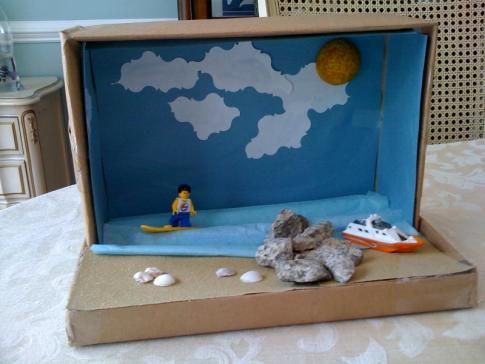
You need a shoebox nothing more,

Then cut out a little door.

Inside the box is just the space,

For you to make a special place.

Is it a tiny teddy’s home?

Or a world where dinosaurs like to roam?

Does it hide treasure or a golden key?

A pirate’s world for all to see?

Is it a space adventure with moon and stars?

With rockets racing off to Mars?

Or you could make it a minature zoo,

With monkeys, lions and tigers too.

Put the lid on and open the door

Let’s see the world that you adore.
“Forty Days in Italian”  by Celia Berrell

Leave a comment


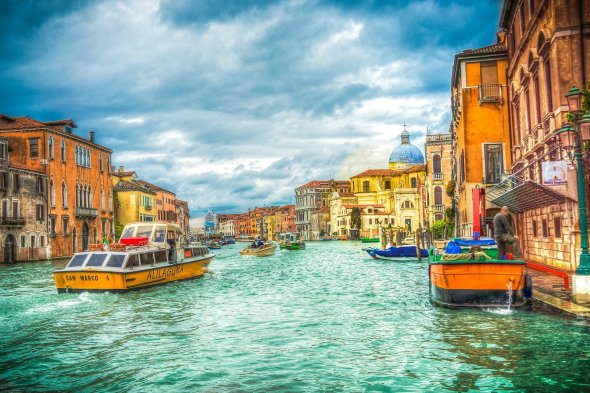
Venice, in the Middle Ages

feared infection from the boats

that visited its harboured stages,

ordering sailors to “stay afloat!”

For forty days they had to anchor.

NOT set foot on Venice land,

to make sure none were sick and rank

or had bubonic plague at hand.

Quaranta giorni (Kwa-rant-a jee-or-nee)

Quaranta giorni (Kwa-rant-a jee-or-nee)

is “Forty Days” in Italian.

That’s where the word for isolation

known as QUARANTINE began.


https://www.dictionary.com/e/quarantine-vs-isolation/

What does quarantine mean?

In general, quarantine is “a strict isolation imposed to prevent the spread of disease.” We know what you might be thinking: so, quarantine is … just an isolation? Not exactly.

As the Centers for Disease Control and Prevention (CDC) explains, the practice of a quarantine specifically involves:

the separation of a person or group of people reasonably believed to have been exposed to a communicable disease but not yet symptomatic, from others who have not been so exposed, to prevent the possible spread of the communicable disease.

The takeaway: People are put in quarantine when they are not currently sick, but have been or may have been exposed to a communicable disease. This can help stop the spread of the disease.

Voluntary quarantine (when someone isn’t ordered to go into quarantine but chooses to do so just out of caution) is often called self-quarantine.

Entering English in the early 1600s, this “isolation” sense of quarantine comes from the Italian quarantina, a period of forty days, derived from quaranta, the Italian for “forty.” (The Italian quaranta, if you’re curious, comes from the Latin quadrāgintā, also meaning “forty.”)

What’s so special about 40? Historically, quarantine referred to a period—originally of 40 days—imposed upon ships when suspected of carrying an infectious or contagious disease. This practice was done in Venice in the 1300s in an effort to stave off the plague.
 

“A world of teddies” by James Aitchison

Leave a comment


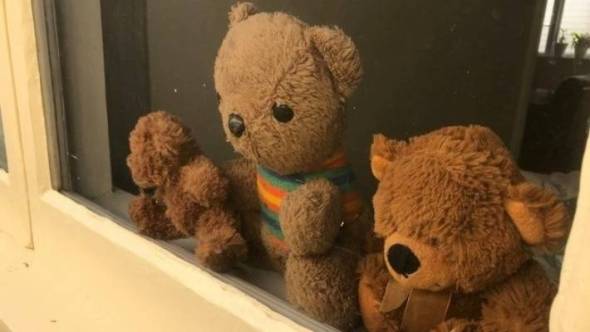
I spy as I pass by

A teddy in a window

Watching me!

Oh what fun, oh such glee,

A teddy in a window

Watching me!


Wherever I wander,

More teddies I see

Sitting in windows,

Watching me.

Who put them there

Two by two?

I’d like to thank you

And you and YOU!

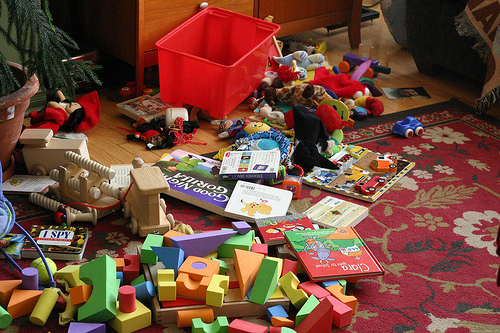
“Closed doors” by Julie Cahill

Leave a comment


Mum, she slammed the door, she did.
‘No one’s going out!’
I scratched my head and wondered what the fuss was all about.
My mother often sent us out
so she could clean our mess.
Now our home is inside out with plonked in tardiness.
We play games we have never played
Lose pieces that are loose.
The jigsaw puzzle is in MORE bits
Soggy, with my juice.
The tv stations repeat repeats.
I turn myself away.
Good gracious, it’s as though it is
a winters’ rainy day.
But that’s okay, the storm will pass.
My mum screamed
‘really soon!’
She still believes in nonsence
like ‘the man upon the moon.’
I give that sly and sideways look
The one which she deserves.
But Mum’s a treat
When she hands out sweet
And cuddles with elbows curved.

“A silent Anzac Day” by James Aitchison

Leave a comment