“A SEASONAL TELESTITCH” by James Aitchison

Leave a comment

A SEASONAL TELESTITCH


The end of cold days:

Farewell! Adieu!

The sun rises warm

But expect a quick storm,

Then catch a wave —

It’s my kind of weather!


The sunsets glow red

Across Australia,

We’re all on holiday —

The best of all times!


James Aitchison


 TELESTITCH

A telestitch is the opposite of an acrostic.  Discover the poem’s hidden message by reading the last letter (rather than the first) of each line.

Give it a try

And most of all — have fun!

Aardvark, Ape, Barracuda, Butterfly and Bear by Jan Darling

Leave a comment

Crowds, rabbles and throngs, clubs, hordes and troupes

Are Collectives for people who gather in Groups

But what do we call friends who are woolly and furry

Barking or whistling, singing or purry?

When they get together with family and friends

What is the word for their special blends?


Let’s start with the alphabet, that means the A

Which letter was first from the Ark would you say?

It wasn’t the whale, the worm or the shark –

But a shy bunch of prickles we call the Aardvark.

If you should meet lots of aardvaarks at once

And call them an Armoury, you’d not be a dunce.


If you’re keen on games and like jokes and japes

You’ll be happy to meet a grouping of Apes

But what will you call them – this family of jokers…

This smart clever band of naughty provokers?

The word is descriptive, it’s perfectly apt

A *Shrewdness of Apes has them all neatly capped.


Now think of the sea, in the depths of the ocean

Where swims a predator in fast or slow motion

He is hunted and eaten, grows more than three meters

Provides tasty meals and feeds plenty of eaters

He’s a high-powered fish and fond of flattery

When found in groups it’s a Barracuda Battery.


Our next group of B is from land, not the sea

And some of his kind live and sleep in a tree

Some like the snow, others the jungle

The name for this lot seems a silly bungle

It’s a **Sleuth or a Sloth when you see many Bears

An affliction of fiction from hundreds of years.


The last of our B’s flies dainty and free

Over the land but seldom the sea

She does beautiful things with colourful wings

She dances o’er flowers as the sweet bird sings

A Flutter of Butterflies is commonly heard

But Kaleidoscope’s often the Collective word.

 Jan Darling

Teaching Notes: 

Sounds of the Aardvark:  soft grunts as it forages (looks for food like ant nests); loud grunts as it approaches its nest entrance and soft bleats if frightened.

  • What do you call a group of Aardvarks?
  • How many ‘As’ are there in Aardvark?

Sounds of the Ape: sounds like something between a series of dog yaps and UGH!​ The sound is called a ‘jibber’.

  • What do you call a group of Apes?
  • What is the meaning of ‘shrewd’?

*Shrewd means both clever and sharp.   Apes are known to observe you closely, often appearing to deduce what your next move will be.

Sounds of the Barracuda:  Sadly, most fish sounds are inaudible to the human ear.  But if we could hear them, fish-talk would sound like purrs, grunts, hums, clicks and hoots.

  • What is a group of Barracuda called?

Information not included in the poem: Barracuda can grow up to 100 cm and weigh up to 9 kilos.    They can live 10-15 years because they have few natural predators – only man, sharks and the Orca whale.

Sounds of Bears:  Each Bear family has a different sound, they growl and when angry they roar, Bear cubs make a hoarse bawl when they’re scared, they also make whuffing noises and they moan and grumble.

  • What is the name for a group of Bears?
  • What characteristic does this name imply?

**Both Sleuth and Sloth come from Old and Middle English.  Some writers associate the idea of Bears often seeming to look for things with ‘sleuth’ or detective.  Most agree that Sloth comes from Old English Slow-th, meaning slow.  We now know that not all Bears are slow.  In fact you should never run from a bear – he can cover 50 yards in 3 seconds!   And your running will just encourage him.  

Yards: an imperial measure equal to the metric measure of 0.9144m. Discuss Imperial and Metric measures.

  • What sounds do baby bears make?

Sounds of the Butterfly:  they flutter – an onomatapoeic word. Onomatapoeia is a “figure of speech” – it describes a word that itself sounds like the subject it refers to!

What are examples of onomatapoeiac words?

  • Baa-lamb.  Baa is the sound that the lamb makes.  
  • Or sizzle – the sound that the steak makes.
  • Buzz – the sound a bee makes.

What is a group of butterflies called?

Information not included in the poem:  The butterfly has four different stages of growth: the Egg, 100-300 are laid at a time.  The Caterpillar: the egg produces a caterpillar which grows to its final size and then becomes the Pupa (which are usually attached to the underside of a leaf), which finally produces the Butterfly.

All sounds are available online.  Simply Google ‘Sound of the …’ and you will be taken either to a dedicated website or to YouTube.

 

“A Tribute to WWI Military Dogs” by Robyn Youl

Leave a comment


LEST WE FORGET.

11/11/19-18   >  11.11.2018

HIS MASTER’S VOICE.

A Tribute to WWI Military  Dogs


His Master’s Voice has gone

Dogs do not understand goodbye

He watches waits and grieves

Why do the women cry?


A War Dog has a focus

Love dictates the choice

The wailing shells surround him.

His world, His Master’s Voice


He did not care to understand

Why humans kill or play

Be it German, French or English

His Master’s Voice his day


Evading deadly Allied Bullets

On German Voice command

A precious load strapped to his back

He skims the mire of No Man’s Land


Blueruns with army orders now

There are no sheep or cattle

Blueonly hears His Anzac’s Voice

Above the roar of battle


A Red Cross Dog saves lives

Aiding those who still draw breath

The Stretcher Bearer’s Voice

Braves the screaming stench of death


Flanders fields are still blood red

Killing is still glorified

Men and dogs are still at war

Will we ever turn the tide?

Robyn Youl


Notes:

Both sides trained Military Dogs.

World War I dogs were used to carry messages, first aid kits and transmission wiring. Some dogs were army mascots.

Small dogs were also useful in the trenches to kill the hordes of rats that swarmed  in the filth and squalor. Removing sick and dead men from the trenches was difficult. They were high, narrow and usually had stagnant water lying in them. Rats thrived.

The rule was Keep your Head DOWN!!! Sharp shooters on the other side of No Man’s Land were just waiting to put a bullet into any head that poked up.

No Man’s Land was the distance between enemy trenches. It was covered on barbed wire. After the troops had come out of the trenches to Charge the Enemy, No Man’s Land was the place of the dead, the injured and the dying.

The sound of shelling, machine gun and rifle fire began at daylight and did not finish until it was too dark to see.

At night the stretcher-bearers were busy taking the wounded to safety. Other soldiers were collecting Dog Tags or Identity Discs from the dead. These were used to change the records to Killed in Action and send a telegram and letter to the next of kin.

The Australian Armed Forces still train war dogs. If you love dogs you might like to find out more about them.

Horrie the War Dog by Roland Perry is an interesting yarn about a dog who worked with the Australian Army in Egypt.


“Sea Stalker” by Mary Serenc

Leave a comment


Teacher Notes by Jeanie Axton

1. Brainstorm words that describe sharks in general

This could be a starting point

http://www.rhymezone.com/r/rhyme.cgi?Word=shark&typeofrhyme=jjb

2. Look at the structure of a shark


3. Discuss students experiences of sharks and bring in the topic of shark safety

4. Now with all the brainstorming, knowledge and safety awareness of sharks start writing

5. Younger students could paste their poem in the shape of a shark for displaying in the classroom

”Cyrch a Chwta: a Challenge!” by James Aitchison

Leave a comment

Cyrch a Chwta: a Challenge!

My cat adores nothing more

Than salmon, whiting and flake.

And as for my Labrador,

He demands a juicy steak.

But they will not eat them raw —

I cook them, for heaven’s sake!

My parrot says I’m cuckoo.

What to do?  I need a break.

James Aitchison

Cyrch a Chwta (pronounced kirch a choota), is a fun Welsh poetic form which has:

  1. An octave stanza (eight lines)
  2. Seven syllables per line
  3. A choice of two rhyming patterns: aaaaaaba or abababcb; the big trick is Line 7, which has to cross-rhyme internally with Line 8, on either the third, fourth or fifth syllable!

In my poem above, the schematic is:

xxxxxxa
xxxxxxb
xxxxxxa
xxxxxxb
xxxxxxa
xxxxxxb
xxxxxxc
xxcxxxb

“Stain” by JR Poulter

Leave a comment

A Rhupunt for Spring by James Aitchison

Leave a comment

A RHUPUNT FOR SPRING

Spring’s colour thrills
when daffodils
and bold jonquils
burst into bloom.

Tulips tower,
freesias flower,
colours shower,
banishing gloom.

All spring we’re blessed;
bulbs give their best,
’til time to rest
in a dark room.

James Aitchison

A RHUPUNT (pronounced hree’-pintis a Welsh poem with some curious rules:

  1. Each line must have four syllables
  2. The first three lines of each stanza must rhyme
  3. The final line of each stanza must rhyme with the final lines of the other stanzas (in other words: aaab, cccb, dddb, eeeb, etc)
  4. Each stanza works as a complete sentence or verse in itself.
  5. If you prefer, stanzas can have three lines (aab, ccb, etc) — or five lines (aaaab, ccccb, etc) — it’s up to you.

“Sally’s Treasure” by Pat Simmons

Leave a comment

Sally’s Treasure

Sally McPhee’s a collector of keys.

She keeps them concealed in a drawer.

Some she has found just lying around.

But several she stole from next door.


She has keys that fit windows

and keys for the shed.

She’s got keys for a diary

she hasn’t yet read.


She has keys for a money box

owned by her brother.

And keys for the Volvo,

misplaced by her mother.


She has keys for a tool box,

her father’s great treasure.

To see him in search mode

gives Sally such pleasure.


She has keys that are ancient

and keys that are new.

Well, people are careless,

that’s Miss Sally’s view.


Sally McPhee’s a collector of keys.

She keeps them concealed in a drawer.

Her intention is clear.

That year after year,

she’s  going to collect hundreds more.


Teacher Notes: by Jeanie Axton

What are the keys to engage children with poetry?

Check out this site especially the “Ten Top Tips to Engage Kids with Poetry” 

https://www.thebookchook.com/2014/04/ten-top-tips-to-engage-kids-with-poetry.html

There is even a link to The Australian Children’s Poetry website.


“Coco Cough-not” by Celia Berrell

Leave a comment

Coco Cough-not

A wintery cough

can feel rather tough.


Persistent and hacking

it sends our smiles packing

then steals counted sheep

so we can’t get to sleep.


Now would you cheer up

to know help’s in a cup?


It turns out that coco

all jolly and ho-ho

can soothe our cough ills

even better than pills.


This chocolate goldmine

contains theobromine

and as we’d expect,

has no ill-effects.


With this coco-cough link, have a hot chocolate drink!
https://www.newscientist.com/article/1919209-persistent-coughs-melt-away-with-chocolate

An ingredient in chocolate may actually be a more effective cough medicine than traditional remedies, a new study suggests.

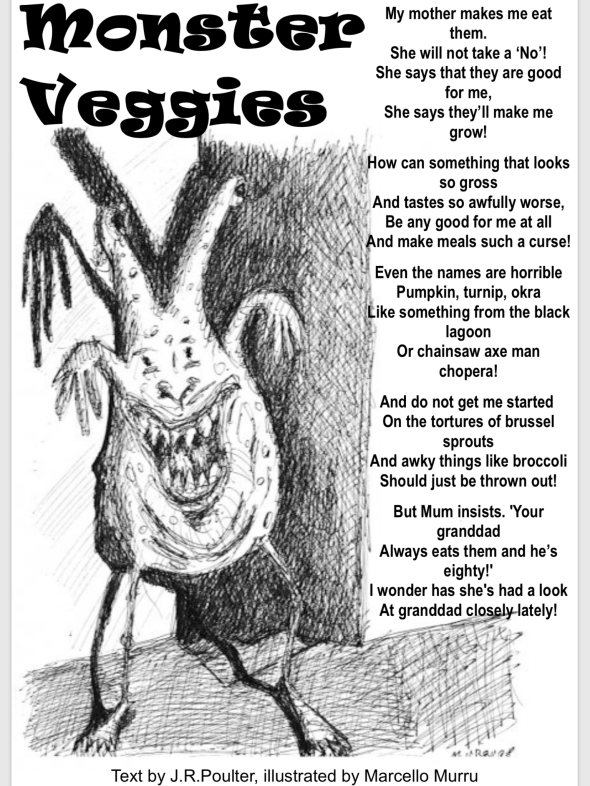
“Monster Veggies” by JR Poulter

Leave a comment

Veggie Monster – teacher notes –

Activity – Class debate on “Advertising and Prime Time TV, Their Role in Demonising Vegetables” 

Activity – Make up an advertising campaign to popularise vegetables. Research TV advertisements and  prime time TV shows to see what sort of food is promoted and how. I can think of one popular TV soapie, which has its cast eating pizza and drinking beer in most episodes. What does this say to young viewers. 

Note what sort of advertisements come on between 4.00pm and 8.00pm, the time many children, families and young folk would be watching TV. How might you use your campaign to change this?

Activity – Make up recipes with vegetables as the main ingredients – they must be delicious enough that YOU would want to eat them! If there are any vegetarians in the class, ask them to be a consultative panel and to judge the result of the class cooking attempts to make veggies into taste tempting foods!